HomeToGo vs Google Vacation Rentals: A Hosts Complete Guide
In the highly competitive short-term rental market of 2026, relying on a single booking platform is no longer a viable business strategy. Professional property managers and ambitious independent hosts know that a diversified channel mix is the key to maximizing occupancy, securing higher margins, and future-proofing their business against algorithmic shifts. To capture specialized traveler demographics while simultaneously boosting direct revenue, operators are increasingly looking beyond the traditional duopoly of Airbnb and Vrbo.
Today, a critical strategic comparison for European and North American hosts is HomeToGo vs. Google vacation rentals.
Historically, both platforms began in the vacation rental space as metasearch engines—aggregating listings from other sites. However, as of 2026, their business models have diverged completely. HomeToGo has evolved into a fully fledged Online Travel Agency (OTA) with a massive, dedicated user base, while Google Vacation Rentals has cemented its position as the ultimate zero-commission, direct-booking metasearch engine.
In this comprehensive, 1,500+ word deep-dive, we will break down the fundamental differences between HomeToGo and Google Vacation Rentals. We will explore their fee structures, guest demographics, algorithmic visibility, and how modern property managers are leveraging property management software to perfectly synchronize both channels for maximum revenue.
1. The Core Ecosystem: The Niche OTA vs. The Global Search Engine
To successfully integrate these channels into your distribution strategy, you must first understand how their underlying technology and business models have evolved in recent years.
HomeToGo: The Evolution into a Direct Marketplace
For years, HomeToGo operated strictly as a metasearch platform—scraping listings from Airbnb, Vrbo, and Booking.com, and redirecting users to those sites. However, leading into 2026, HomeToGo successfully pivoted its business model toward "Onsite Bookings."
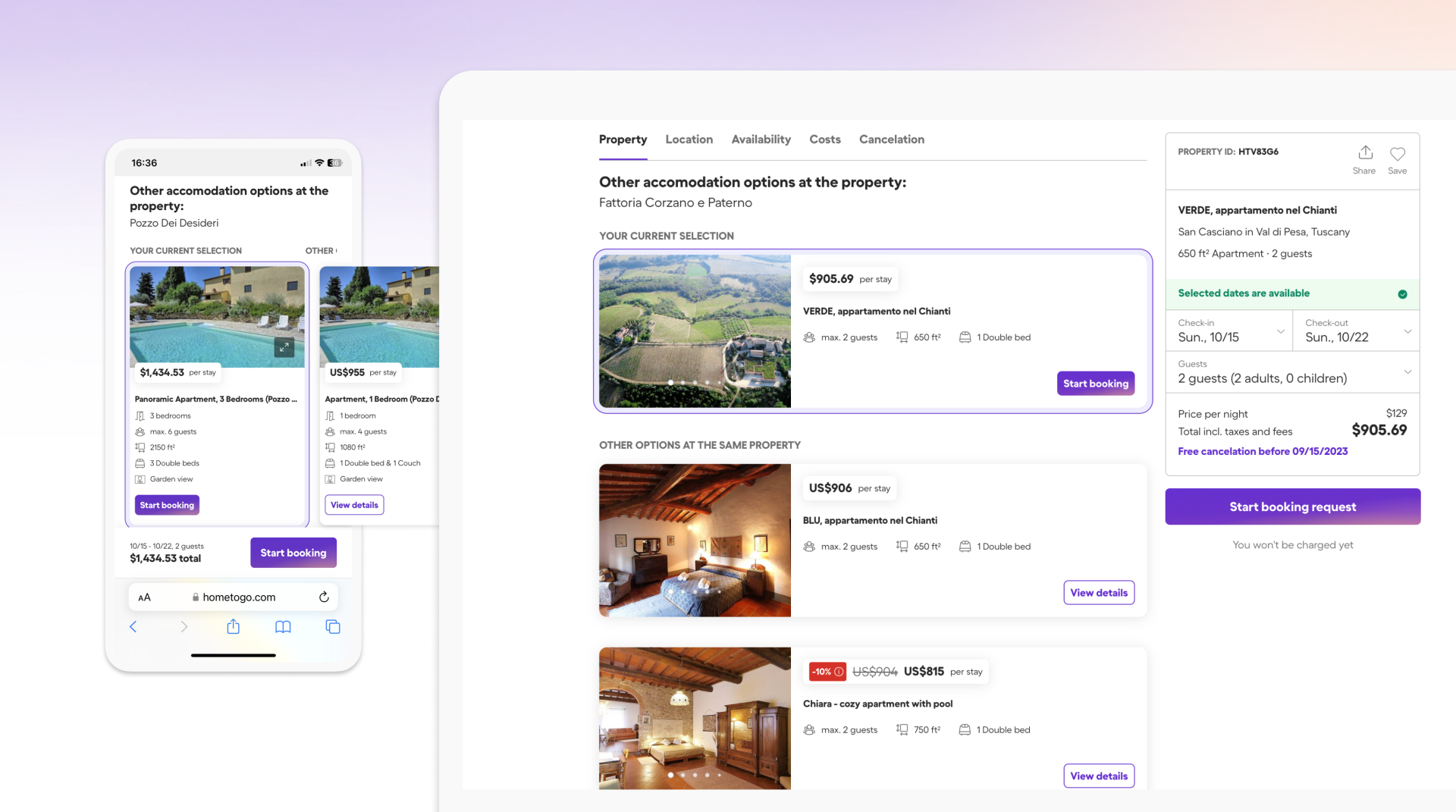
Today, HomeToGo functions primarily as an OTA. Through its HomeToGo_PRO division and deep integration with its subsidiary Interhome, the platform now encourages guests to complete the entire booking transaction without ever leaving the HomeToGo app or website. By serving as the merchant of record for these transactions, HomeToGo provides a seamless guest experience and lower cart abandonment rates. For hosts, this means you can list your property directly on HomeToGo (via an API connection) to tap into their highly loyal, high-budget traveler base without routing them through a third-party OTA first.
Google Vacation Rentals: The Pure Metasearch Disruptor
Google Vacation Rentals (GVR) took the opposite path. Instead of trying to become an OTA, Google leaned into its core strength: owning the top of the internet search funnel. GVR acts purely as a metasearch discovery layer deeply embedded within Google Search results and Google Maps.
When a family searches for "cabins in the Smoky Mountains," Google’s algorithm pulls live pricing and availability directly to the top of the search results. But unlike HomeToGo, Google does not take bookings or process payments. When the guest clicks "Book," Google redirects them straight to your direct booking website. You own the customer relationship from the very first click, completely bypassing traditional platform middlemen.

2. Head-to-Head: 2026 Feature Comparison Table
How do these platforms compare at a glance for a professional property manager?
| Feature / Metric | HomeToGo (Onsite Booking) | Google Vacation Rentals |
| Primary Business Model | Online Travel Agency (OTA) | Metasearch & Direct Booking Redirect |
| Guest Demographic | Families, longer stays, 35+ years old | Universal (Anyone using Google Search) |
| Average Booking Lead Time | Very High (Often 90+ days in advance) | High (Varies by destination search) |
| Host Commission | 3% Split Fee OR 15% Host-Only | 0% (Zero platform commission) |
| Payment Processing | Handled via the host's connected gateway | The host owns the guest data entirely |
| Guest Data Ownership | Shared (Host receives guest info for direct charge) | Massive in Europe/DACH, growing in the US |
| Geographic Strength | Massive in Europe/DACH, growing in US | Global universal dominance |
| Integration Requirement | Channel Manager / API Partner required | Channel Manager / API Partner strictly required |
3. The Financial Reality: Commission Structures and CPA
Understanding the true cost of acquisition (CPA) is the most critical skill for a property manager in 2026. The financial mechanics of the HomeToGo vs. Google vacation-rental debate present two distinct paths to profitability.
HomeToGo's Fee Structure
Because HomeToGo has transitioned to an Onsite Booking model, its fee structure now closely mirrors traditional OTAs like Airbnb and Booking.com. They offer two primary commission models for professional hosts connected via API:
- The Split Fee Model: The host pays a baseline 3% payment processing and platform fee, while HomeToGo adds a variable traveler service fee to the final price the guest sees.
- The Host-Only Fee Model: Popular among professional property managers seeking rate control, this model charges a flat 15% commission directly to the host, allowing guests to book with no visible service fees. This often increases conversion rates but requires the host to manually mark up their base rates to absorb the cost.
The Zero-Percent Advantage of Google Vacation Rentals
Google’s financial proposition is what makes it the most disruptive force in the hospitality industry in 2026: 0% commission.
Because Google serves only as a search redirect to your own website, there are no OTA service fees, no host commissions, and no mandatory discount algorithms to appease. Your only financial obligations are the standard credit card processing fee (typically ~2.9% + $0.30 via a gateway like Stripe) and the monthly subscription for your property management software.
By capturing direct traffic through Google, you immediately reclaim the 15% you would have surrendered on an OTA platform.
Key insight: Bypassing a standard 15% commission on a 7-day family vacation booking can instantly add hundreds of dollars of pure profit to a single reservation. Over a year, GVR can completely transform a property's Net Operating Income.
4. Target Audiences & Booking Behavior
To maximize your revenue calendar, you must understand who is using these platforms and how their booking behaviors differ. This is where the true value of a multi-channel strategy shines.
The HomeToGo Guest: High-Value Families and Planners
HomeToGo holds an incredibly strong market position in Europe (specifically the DACH region: Germany, Austria, Switzerland) and is rapidly expanding its footprint in North American leisure destinations.
The average HomeToGo guest is vastly different from an urban Airbnb user. They skew slightly older (35+), are heavily family-oriented, and use the platform's specialized search filters (such as "fenced yards for dogs" or "saunas") to find specific amenities. Because they are booking large family vacations, their booking lead times are exceptionally long—often securing properties 90 to 120 days in advance. Furthermore, their average length of stay is notably longer, with frequent bookings of full weeks rather than quick weekend getaways. If your property is a large leisure home, HomeToGo is an indispensable source of stable, high-value bookings.
The Google Guest: High Intent and Brand Discovery
Google doesn't cater to a specific niche; it caters to the entire internet. Travelers who utilize Google Vacation Rentals are highly intentional. They begin their journey on a blank search bar, typing exact queries or dragging around on Google Maps to find accommodations near a specific point of interest.
Because they land on your website to complete the booking, you have the immediate opportunity to build a direct brand relationship. They see your logo, read your specific house rules, and agree to your terms of service. This makes them significantly easier to re-target via email marketing for future direct bookings, turning a one-time Google searcher into a loyal, repeat customer.
5. Host Protections, Vetting, and Operational Control
When you diversify away from closed ecosystems like Airbnb, the operational dynamics shift. Both HomeToGo and Google Vacation Rentals rely heavily on hosts to manage guest relationships.
Operating via API Connections
Whether a guest books via HomeToGo's on-site flow or through a Google direct redirect, professional hosts largely operate independently. Neither HomeToGo nor Google acts as a comprehensive insurance provider or dispute mediator.
In both scenarios, you are the merchant of record (via your integrated payment gateway). This gives you incredible power, but also absolute responsibility. You must:
- Process the credit card payments securely.
- Implement your own guest screening protocols (utilizing tools to verify IDs and prevent fraud).
- Mandate digital rental agreements.
- Enforce your own security deposits and cancellation policies.
For professional property managers, this level of control is preferred. It ensures you are never at the mercy of a third-party customer service agent arbitrarily refunding a guest who violated your house rules.
6. The Algorithm Games: Visibility and Rate Parity
How do you ensure your property actually gets seen on these massive networks?
Mastering HomeToGo's Visibility
HomeToGo utilizes advanced machine learning to rank properties. Your visibility on HomeToGo is driven by conversion metrics, photo quality, and Instant Booking. Properties that require manual host approval are heavily penalized in the search rankings. Furthermore, maintaining strict rate parity is critical. If HomeToGo’s algorithm detects that your property is listed significantly cheaper on another OTA, your ranking will plummet.
Mastering Google Vacation Rentals
Google relies on hard technical data, API speed, and absolute pricing transparency. To rank well on GVR, you must provide the best available price. Because Google is a metasearch engine that often shows multiple booking options for the same property, if your direct site offers a lower rate than your OTA listings, Google will prominently highlight your direct website with an "Official Site" badge, dramatically increasing your zero-commission conversion rate.
7. The Tech Stack: Scaling with Smoobu
You cannot manually manage a listing on either platform in 2026. Both HomeToGo and Google Vacation Rentals strictly require properties to be connected through an approved API connectivity partner. Attempting to manually update calendars across multiple channels guarantees disastrous double-bookings.
To successfully execute this multi-channel strategy, you must utilize a powerful property management system (PMS) and channel manager. This is where Smoobu becomes the essential operational hub for your vacation rental business.
As a Premier Connectivity Partner, Smoobu bridges the gap between high-value OTAs like HomeToGo and the direct-booking power of Google Vacation Rentals:
- Instant Calendar Synchronization: When a family books a two-week summer stay on HomeToGo, Smoobu instantly blocks those exact dates on Google Vacation Rentals, Airbnb, and Vrbo in real time—protecting your calendar globally.
- The Google Integration: Smoobu automatically generates a compliant direct-booking website for you and pushes your live rates, availability, and high-resolution photos directly into Google Vacation Rentals' search ecosystem.
- Centralized Pricing Management: You can set a base price in Smoobu and automatically apply channel-specific markups. You can mark up your HomeToGo rates by 15% to absorb their commission, while pushing your base, commission-free rates to Google VR to win the algorithmic price comparison.
- Unified Inbox: Whether a guest messages you via HomeToGo or replies to a direct booking confirmation from Google, every message lands in one centralized Smoobu inbox, allowing you to trigger automated check-in codes seamlessly.
Conclusion: Your 2026 Action Plan
The strategic debate between HomeToGo vs. Google vacation rentals is not about choosing a single winner; it is about deploying both to build a bulletproof revenue machine.
Use HomeToGo strategically to capture high-budget families, secure long-lead-time bookings, and tap into the lucrative European and growing North American leisure markets. Accept their commission in exchange for securing full weeks of occupancy months in advance.
Simultaneously, leverage Google Vacation Rentals to build your direct booking pipeline. Use Google's unmatched metasearch dominance to capture high-intent travelers, bypass OTA fees entirely, and build a database of past guests for future remarketing.
Mastering this distribution mix is the difference between surviving and thriving in 2026. Centralize your tech stack, optimize your rates, and take back control of your business today.
Leave a comment
Your email address will not be published.