
How Much Does it Cost to Run a Vacation Rental? Budget & Guide

Quick Answer: Operating a property is a hospitality business, not a passive income stream. To ensure profitability, hosts must conduct a rigorous audit of their expenses. In our ecosystem, a host is a property owner or manager renting out accommodations.
Additionally, a booking fee is defined as a charge applied to a reservation by the channel of origin.
- Startup Costs: Includes property acquisition, hospitality-grade furnishing, smart home technology, and initial legal permits.
- Fixed Monthly Costs: Your monthly floor includes your mortgage, specialized commercial insurance, high-speed internet, base utilities, and compliance fees.
- Variable Costs: Fluctuate with occupancy and include professional cleaning fees, consumer disposables, linen turnover, and booking fees.
Moving Beyond The "Passive Income" Myth: Why A Profitability Audit Matters
The promise of passive income is the siren song of the property investment industry. It paints a picture of automated bookings, digital nomad lifestyles, and effortless wealth accumulation. However, for the serious investor, the reality is far more grounded.
Operating a property is not a passive endeavor; it is a hospitality business. To succeed, one must pivot from a passive landlord mindset to that of a professional service provider. Profitability does not happen by accident.
It is the result of a rigorous profitability audit and a disciplined approach to managing the math of survival in an increasingly saturated market.
Shifting From Property Owner To Hospitality Provider
Many new entrants enter the space expecting to collect checks while doing little more than managing an online calendar. A calendar provides a centralized view of all your bookings, availability, and blocked dates across connected channels. Relying purely on automated availability is a fundamental misunderstanding of the sector.
When you list your property on a channel, which is an online platform where listings are advertised, you are entering the service industry. Guests expect hotel-grade cleanliness, seamless check-in processes, and immediate responsiveness. A guest is a traveler who books and stays at a property.
Failure to provide this level of service results in poor reviews, lower search rankings, and a rapid decline in bookings. A booking is a confirmed reservation made by a guest. Every aspect of your property, from the quality of the bedding to the speed of your WiFi, must be optimized for guest satisfaction.
The Importance Of The "Math Of Survival" In A Saturated Market
As supply grows, the math of survival becomes your most critical tool. You must understand that a down month or a regulatory shift is not a catastrophe if you have accounted for it in your budget. If you rely on 100% occupancy to pay your mortgage, your business is fragile.
Occupancy refers to the status of having properties booked by guests during a specific time period. A realistic budget must account for seasonal dips, unexpected maintenance, and potential tax hikes. Treating your property as a business means calculating your monthly floor.
This is the absolute minimum cash flow required to keep the lights on and the liability covered, regardless of how many nights are booked. Ensure your baseline revenue covers fixed costs and unexpected buffers to survive these seasonal dips.
The Barrier To Entry: Initial Startup Costs
Property Acquisition And Mortgage Considerations
The cost of entering the property business begins long before your first guest arrives. Beyond the down payment and closing costs, you must account for the unique financing challenges of investment properties, which often carry higher interest rates than primary residences.
Your mortgage is your largest fixed debt, and ensuring it is leveraged correctly is the cornerstone of your financial planning. As a baseline, we always refer to our users' rental units as properties.
Furnishing And Interior Design: Investing In Guest Satisfaction
Unlike a standard rental, a vacation rental property experiences extreme wear and tear. You are not just buying furniture; you are buying hospitality-grade equipment that must survive heavy usage. Investing in high-quality mattresses, durable sofas, and stain-resistant textiles is a capital expenditure that pays dividends in guest satisfaction and the longevity of replacements.
Budgeting for a recurring replacement cycle, typically every two to four years for high-traffic items, is essential for maintaining your competitive edge. Note that in our standard formatting, numbers lower than 10 are spelled out.
The "Tech Stack" Essentials: Smart Home Technology And WiFi
Efficiency is the antidote to the passive income myth. Investing in a robust tech stack allows you to manage your property remotely without sacrificing service quality. A $20 monthly subscription for a smart lock or a channel manager can save you hours of manual labor per week.
High-speed internet is no longer an amenity; it is a utility that attracts high-paying remote workers who demand reliable WiFi.
The Cost Of Legality: Permits, Licenses, And Compliance
Navigating Local Regulations: Licenses And UBI Numbers
The regulatory landscape for properties is tightening globally. You must obtain the necessary permits and, in many jurisdictions, a Universal Business Identifier (UBI) number. These are not one-time costs.
Many cities require annual renewals and periodic site inspections.
Location-Specific Examples: From San Juan County To Permit Sonoma
Regulatory environments vary wildly. In regions such as San Juan County or within the purview of Permit Sonoma, becoming a legal operator is intensive and costly. Researching your specific county's ordinances is a mandatory step before purchasing a property.
If you fail to account for the ongoing costs of regulatory compliance, you risk a compliance trap in which your legal fees and fines eventually erode your entire profit margin.
The Financial Impact Of Compliance And Taxes
- Fire Safety Equipment: Compliance is not optional. Every property must be equipped with fire extinguishers, smoke detectors, and carbon monoxide alarms in accordance with local fire codes. Ignoring these requirements exposes you to massive liability.
- Fire Inspections and Certificate of Compliance Fees: Budgeting for periodic inspections is a necessary overhead. These fees ensure you remain in good standing with local government and insurance providers. Never treat these as surprise expenses; they are fixed costs of doing business.
- Transient Occupancy Tax (TOT) and Local Sales Tax: Most municipalities impose a TOT in addition to the standard sales tax. Failing to collect and remit these taxes correctly can lead to severe legal consequences. Use automated tax-collection features in your channel connections to minimize errors, but always maintain a manual ledger to ensure full compliance.
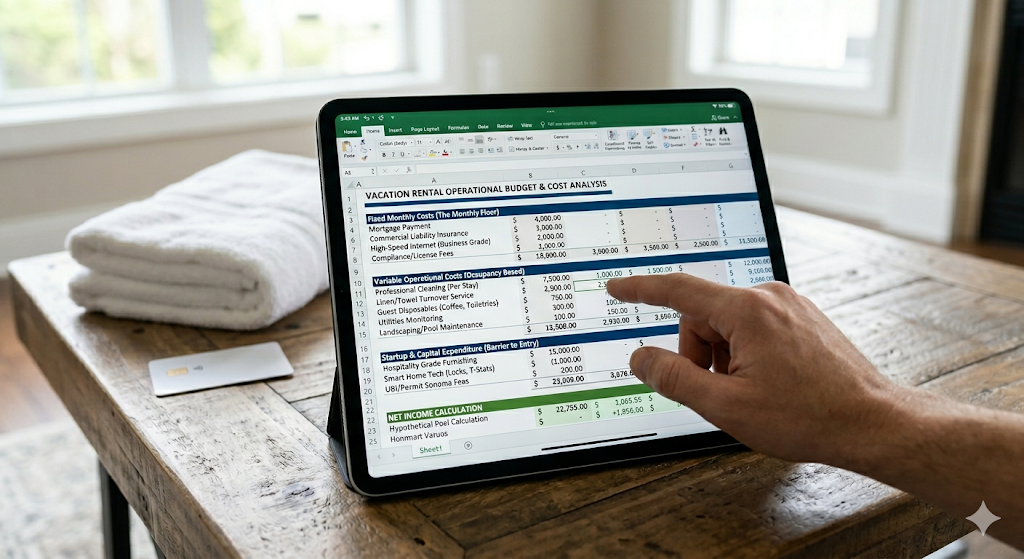
Fixed Overhead: The "Monthly Floor" Of Your Budget
- Essential Utilities: Your utility bills will be higher than those of a standard residential property. Guests often leave lights on or keep the HVAC running constantly. You must monitor these costs closely and consider smart thermostats to mitigate energy waste.
- High-Speed Internet: Remote work has transformed the property market. Travelers now prioritize high-speed, reliable WiFi above almost any other amenity. Paying for a business-grade internet package helps you secure a higher base price, the standard nightly amount before adjustments.
- Specialized Insurance Premiums: Standard homeowner's insurance will rarely cover business activity. You need a specialized policy that covers commercial liability, property damage, and loss of income in the event of an emergency. This premium is a non-negotiable expense that protects your equity.
Variable Operational Expenses: The Cost Of Hospitality
- The Cleaning Fee Gap: Cleaning is a customer acquisition cost. If your cleaning fee is too low, you will struggle to find reliable cleaners. If it is too high, you risk scaring off potential guests.
- Break-Even Goal: Aim for a break-even model where the guest covers the full cost of a professional turn.
- Guest Supplies and Consumer Disposables: Small details, such as shampoo, coffee pods, and paper towels, add up significantly. These are variable costs that fluctuate with your occupancy rate. Keep a dedicated stock room and buy in bulk to keep your cost per guest as low as possible.
- Linen and Towel Stock: Linen and towels are the items most prone to theft, staining, and wear. Maintain a triple set for every bed: one in use, one in the laundry, and one in storage. This allows for seamless turnover even if a set is ruined.
- Landscaping and Exterior Upkeep: A property's curb appeal is your first impression. If you have an outdoor area, pool, or landscaping, you must have them professionally maintained. A neglected exterior is a red flag for guests and can drastically reduce your asset's value.
Real-World Cost Examples: Urban Vs. Rural Markets
To move beyond theory, it helps to examine the actual numbers of running a property across distinct markets. Based on updated 2026 industry data, here is how the operational math changes depending on your location:
- Urban US (Chicago, Illinois): In a heavily regulated urban market like Chicago, the median home price sits around $330,000, and standard urban turnover costs apply. A professional clean for a two-bedroom property typically runs $100 to $150 per stay, significantly impacting margins on shorter bookings. Strict regulations mean hosts must budget heavily for local compliance and licensing fees.
- Rural US (Smoky Mountains, Tennessee): Managing a rural, high-occupancy cabin comes with unique, intensive expenses. The average annual revenue for a property in the Smoky Mountains in 2026 is approximately $65,700, with an average daily rate of $311 and an occupancy rate of around 58%. A standard three-bedroom cabin often requires flat cleaning fees of $150 to $300 per stay, as well as specialized hot tub maintenance.
- Urban UK (London, England): Operating a property in London yields an average annual gross income of roughly £24,700. In this landscape, high operational costs directly bite into profits. Cleaning fees are a major variable, while specialized public liability insurance and professional property management fees further reduce the monthly take-home.
- Rural UK (The Cotswolds): Properties are incredibly lucrative but labor-intensive. The Cotswolds currently ranks as the highest-earning UK holiday-let region in 2026, with an average gross income of £30,600. However, rural owners spend a substantial portion of their budgets on physical upkeep, with maintenance and utility bills costing thousands of dollars annually.
Marketing And Distribution: The Cost Of Getting Booked
Platform Fees
Booking fees are a significant percentage of your Gross Booking Value (GBV). GBV is the total monetary value of all bookings before deduction of fees, commissions, or taxes. Every distribution channel takes a slice of the pie.
Understand the commission structures for each channel connection and diversify your distribution to avoid relying on a single algorithm. A channel connection is the integration linking the host's property to a channel.
Professional Photos And Marketing Strategy
In the world of property management, photography is your storefront. Poor images lead to low click-through rates. Investing in professional photography is one of the highest-return-on-investment marketing decisions you can make.
Tech Subscriptions And Integrations
Pricing your property manually is a recipe for low revenue. Integrations are external tools and services connected to enhance functionality. Tools that track local demand and adjust prices in real-time are essential.
While these services have a monthly cost, the increased revenue they drive easily justifies the expense.
Dynamic Pricing And Revenue Management
The goal isn't just to be booked; it's to be booked at the highest possible guest price. Guest price is the total amount a guest pays, including the price plus all applicable fees, taxes, and other charges. Dynamic pricing allows you to capture more value during peak seasons while remaining competitive during off-peak times.
Professional Management Vs. The Value Of Your Time
If you are unable to manage your property yourself, a professional manager or an assistant can handle the heavy lifting. Assistants are team members of a user's rental business who own sub-accounts with write access. Fees typically range from 15% to 30% of GBV.
While this cuts into your profit, it frees you to focus on other investments or simply reclaim your time. Evaluate your hourly rate honestly. If you are spending 20 hours a month on guest communication and maintenance coordination, you may find that hiring a professional is more cost-effective than sacrificing your personal time.
Guest communication refers to the feature set for sending and receiving messages between hosts and guests.
Conclusion
Running a property is a sophisticated business that requires a shift from passive observation to active management. By focusing on the math of survival, you can ensure your investment remains profitable even when market conditions shift. The keys to sustainability include a robust tech stack, professional cleaning standards, and strict adherence to local regulations.
Remember that every expense, from high-speed internet to the smallest guest amenity, serves a function in either capturing revenue or protecting your asset. To move from an expensive hobby to a profitable business, you must track these metrics as if you were a corporate entity. Regularly conduct profitability audits, maintain a substantial cash reserve, and never underestimate the value of professional help.
If you treat your property with the same rigor you would apply to any other high-stakes business, the reward will be a long-term, cash-flowing asset that stands the test of time. Your next step is to audit your current profit and loss, set your monthly floor, and ensure your operational reserves are primed for the year ahead.