
Short-Term Rental Rules in Your City (2026 UK & USA Update)

Disclaimer: This article provides a general overview of short-term rental rules as of 2026 and does not constitute legal advice. Regulations frequently change at the local, state, and national levels. You should consult local authorities, legal professionals, and your city's official government websites for the most current information regarding your properties.
As the vacation rental market evolves, so do the regulations that govern it. Whether you manage a single property or an extensive portfolio across multiple cities, staying compliant is essential for your long-term success. The landscape in 2026 brings new updates, from mandatory registration requirements to shifting tax policies, across major cities in the United States and the United Kingdom. Navigating these rules ensures you can continue to provide excellent, uninterrupted experiences for your guests without facing sudden penalties or operational hurdles.
In this comprehensive guide, we break down the latest local laws, booking platform policies, and operational requirements you need to know. We want to empower you to self-manage your properties with confidence, efficiency, and ease.
Navigating Short-Term Rental Rules In The United States
New York City, New York
New York City has established some of the most stringent regulations in the United States. These rules are primarily driven by Local Law 18, also known as the Short-Term Rental Registration Law. The full enforcement of this law continues to heavily shape the hosting market into 2026, prompting many operations to pivot toward mid-term stays.
Registration And Compliance
You must register your property with the Mayor's Office of Special Enforcement before you can legally host guests for fewer than 30 days. Booking platforms like Airbnb and Vrbo are legally prohibited from processing transactions for unregistered properties, meaning you will be blocked from receiving guests without proper documentation.
To secure a registration, strict conditions must be met. The property must be your primary residence, meaning you live there permanently. You must be physically present inside the property during the guest's entire stay. The maximum occupancy is two guests, and they must have unobstructed access to all parts of the property, including exits and kitchens. You cannot lock off individual bedrooms.
Registration requires submitting proof of residence, such as a driver's license or utility bill, alongside your lease or deed. If you rent the property, you need the landlord's explicit written consent. In buildings governed by co-op or condo boards, you must have board approval.
Exemptions And Taxes
Properties classified as "Class B" multiple dwellings, such as licensed hotels, are exempt from these specific registration rules. Stays of 30 consecutive days or more fall completely outside the city's short-term vacation rental jurisdiction.
If you register successfully, you must navigate a complex tax landscape. This includes a 4% New York State sales tax, a local sales tax, the Hotel Room Occupancy Tax, and a nightly fee per property. Failing to comply can result in severe financial penalties. The city can demand three times the collected revenue plus up to $5,000 per unregistered transaction.
Los Angeles, California
In Los Angeles, the Home-Sharing Ordinance dictates how hosts can operate. The city aims to protect the availability of residential housing while allowing residents to earn supplemental income in a structured manner.
Home-Sharing Permits
You can only operate a short-term vacation rental for stays of one to 29 days in your primary residence. A primary residence is defined as the place where you reside for more than six months of the year.
Los Angeles offers two types of permits. The regular permit allows you to rent your property for up to 120 days per calendar year. If you wish to host for more than 120 days, you must apply for an extended permit. This involves stricter criteria, a thorough review of your neighborhood citation history, and significantly higher application fees.
Starting in 2026, Los Angeles implemented a new requirement. You must obtain a police permit directly from the Los Angeles Police Department. This ensures the property meets elevated safety standards and requires the primary host to pass a criminal background check.
Rent-stabilized properties and most accessory dwelling units are entirely ineligible for home-sharing.
Operational Requirements
You are required to prominently display your registration number on all digital listings. The city enforces strict occupancy limits to prevent overcrowding. You can host two guests per habitable room, plus two additional guests, for a maximum of 12 people per booking.
Essential safety equipment, including smoke detectors, carbon monoxide detectors, and a fire extinguisher, must be installed and properly maintained. You must provide a guest guide detailing noise regulations, as amplified sound is strictly prohibited after 10:00 pm. Violations can result in fines up to $2,000 per day or the immediate revocation of your permit.
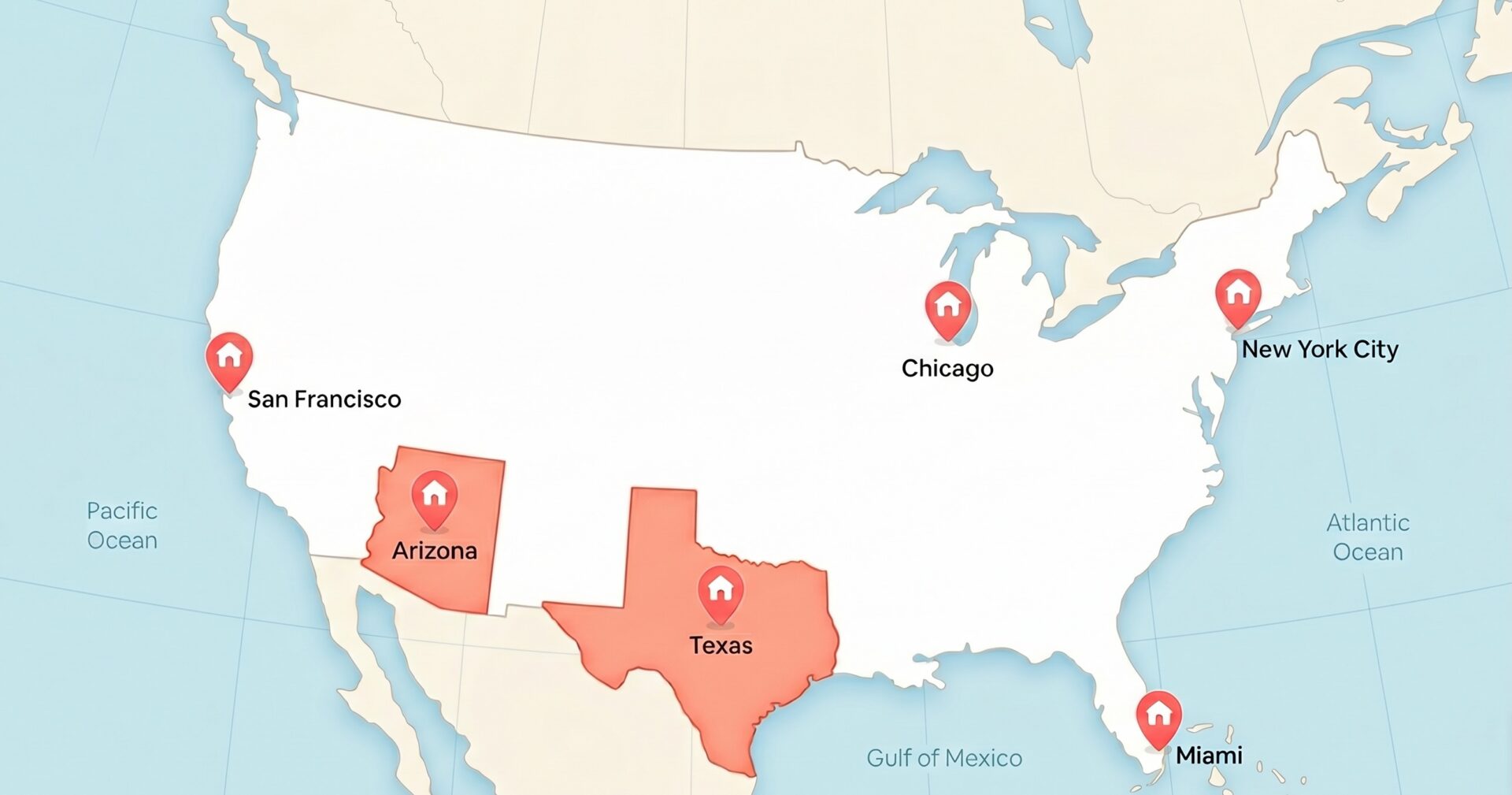
San Francisco, California
San Francisco mandates clear, rigorous operational rules through its Office of Short-Term Rentals. The city focuses heavily on preserving its limited housing stock and ensuring that neighborhoods maintain their residential character.
Primary Residence Requirement
Similar to other California cities, you can only register your primary residence. You must live in the property for at least 275 days out of the calendar year. This strictly prohibits commercial investors from purchasing secondary properties solely for short-term vacation rentals. You must obtain a Business Registration Certificate and a Short-Term Residential Rental Certificate.
The Annual Unhosted Cap
San Francisco enforces strict limits on annual operations. An unhosted stay occurs when you rent out the entire property while you are absent. Booking platforms are heavily integrated with the city's digital registry to automatically track these days and block further bookings once the limit is reached. There is no limit on "hosted" stays, in which you remain physically present at the property during the guest's visit.
Safety And Compliance
Properties must pass rigorous building and safety inspections. Any outstanding code violations will prevent you from obtaining a certificate. Additionally, hosts are required to maintain liability insurance of at least $500,000 or ensure the booking channel provides equivalent coverage. You must also collect and remit the city's Transient Occupancy Tax quarterly.
Chicago, Illinois
Chicago manages its vacation rental market through the Shared Housing Ordinance, balancing the economic benefits of tourism with robust neighborhood preservation.
Licensing And Precinct Bans
All hosts must obtain a license from the Department of Business Affairs and Consumer Protection. Chicago allows both primary and secondary properties to be rented, but the rules differ significantly by property type.
A unique feature of Chicago's regulation is the ability of residents to petition for restricted residential zones. In these specific voting precincts, short-term vacation rentals are completely banned. You must verify that your property is not located within a restricted zone before applying for a license. The active enforcement of registration requirements in cities like Chicago has significantly decreased the supply of non-compliant properties across heavily regulated neighborhoods.
Operational Standards
The city strictly limits the number of properties that can be listed within multi-property buildings. In a building with two to four sub-properties, only one can be used as a short-term vacation rental.
Hosts must adhere to noise and nuisance ordinances. Chicago maintains a firm "three strikes" rule. If a property receives three verified noise or nuisance complaints within 12 months, the license can be permanently revoked. The city imposes a Hotel Accommodation Tax and a domestic violence surcharge on every booking, and you must accurately track them.
Miami, Florida
Miami's approach to short-term vacation rentals focuses heavily on zoning laws, state licensing, and local use certificates. It is critical to understand exactly where your property is located within the city's complex grid.
State And Local Licensing
Operating in Miami requires approval at both the state and city levels. First, you must obtain a vacation rental license from the Florida Department of Business and Professional Regulation. You must also register with the Florida Department of Revenue to collect and remit appropriate taxes.
At the local level, you need a City Certificate of Use and a Business Tax Receipt. The Certificate of Use involves a rigorous property inspection to ensure complete compliance with structural and fire safety standards.
Zoning And Occupancy Restrictions
Miami classifies short-term vacation rentals as a lodging use. They are permitted only in specific zoning districts outlined in the city's code. They are completely banned in T3 and T4-R zones, which consist mostly of single-family and low-density residential neighborhoods.
Occupancy is tightly limited to two guests per bedroom, plus two additional people, with a hard maximum of 12 guests per property. Miami-Dade County also mandates strict swimming pool safety measures. If a property has a pool without specific safety barriers or alarms, children under six cannot stay there.
Texas: Austin And Dallas
The regulatory landscape in Texas is heavily localized, with major cities taking divergent paths into 2026.
Austin's Tiered System
Austin categorizes properties into three distinct tiers. Type 1 applies to primary residences. Type 2 applies to single-family secondary properties. Type 3 covers multi-family secondary properties.
Austin stopped issuing new Type 2 licenses years ago, so you can generally operate a secondary property only in specific commercial zones. All properties require an active operating license, which involves an annual fee, proof of property insurance, and a certificate of occupancy. Austin enforces strict occupancy limits: up to 10 adults, with no more than six unrelated adults per group. You must collect and remit the local Hotel Occupancy Tax.
Dallas Zoning Bans
Dallas implemented sweeping changes that took full effect recently. The city amended its development code to define short-term vacation rentals as a distinct lodging use and subsequently banned them entirely in all single-family residential neighborhoods. Properties can now only operate legally in multi-family and commercial zoning districts.
Arizona: Statewide Rules And Scottsdale
Arizona is unique because state law historically preempts local municipalities from enacting outright bans on short-term vacation rentals. However, a recent state bill granted cities the authority to regulate operations more tightly, and cities like Scottsdale have used this authority extensively.
Scottsdale Regulations
While Scottsdale cannot ban your property, it requires a mandatory local license. The city enacted these rules primarily to combat nuisance complaints and maintain community safety.
You must provide the city with a dedicated emergency contact who can respond to complaints within one hour. You must legally notify all neighbors adjacent to and directly across the street from your property that your property is operating as a short-term vacation rental.
Scottsdale imposes severe fines for violations. Hosting special events, such as weddings or large parties, without proper permits can result in immediate license suspension. Repeated noise violations will trigger escalating financial penalties.
Navigating Short-Term Rental Rules In The United Kingdom

London, England
London hosts have navigated specific restrictions for nearly a decade, but 2026 brings new national frameworks and tax shifts that demand careful attention from property managers.
The 90-Day Rule
Under the Deregulation Act 2015, you can rent out an entire residential property in Greater London on a short-term basis for up to 90 nights per calendar year. This limit resets annually on January 1. Booking channels automatically cap listings at 90 nights, but the rule applies cumulatively across all your connected platforms.
If you wish to exceed this limit, you must apply to your local council for planning permission to change the property's use class. This is rarely granted. Crucially, the 90-day rule only applies to entire properties. If you are renting out a single bedroom while you are physically present in the property, the limit does not apply.
Upcoming Registration And Tax Changes
A new national registration scheme is rolling out across England in 2026. Every property will require a unique registration number, which must be prominently displayed on all listings. Platforms will be legally required to remove properties without a valid number. Additionally, a new "C5" planning use class for short-term lets gives local councils more power to control the concentration of properties in high-demand tourist areas.
Hosts must also adapt to significant tax changes. The Furnished Holiday Lettings tax regime was abolished, meaning you can no longer claim full relief on mortgage interest, bringing the taxation of short-term vacation rentals in line with standard long-term residential tenancies.
Edinburgh, Scotland
Edinburgh has established one of the most comprehensive and strictly enforced licensing systems in the United Kingdom to manage its high volume of tourism.
Mandatory Licensing
Every host in Edinburgh must hold a valid short-term let license to operate legally. The entire city is designated as a control area. If you are operating a secondary let, which involves renting out an entire property that is not your principal residence, you must obtain full planning permission for a change of use before applying for a license.
The licensing process requires extensive safety documentation. This includes an electrical installation condition report, portable appliance testing, gas safety certificates, and a comprehensive fire risk assessment. Operating without a license is a criminal offense, carrying severe fines.
The Visitor Levy
Starting in 2026, a new visitor levy applies to all short-term stays in the city. You are strictly responsible for collecting this levy from your guests at the point of booking and remitting it directly to the City of Edinburgh Council.
Wales
Wales introduced sweeping changes to regulate the tourism and housing sectors, which have heavily impacted hosts across the country.
Statutory Licensing Scheme
The Welsh Government implemented a statutory licensing scheme for all visitor accommodation. To obtain a license, you must prove full compliance with national safety standards, including fire safety, gas, and electrical regulations.
Taxation And Occupancy Thresholds
Wales uses tax policy to differentiate between genuine vacation rental businesses and underutilized secondary properties. The government has increased land transaction taxes on the purchase of secondary and rental properties.
To qualify for business rates rather than the much higher council tax premiums, your property must meet strict occupancy thresholds:
- The property must be available to rent for at least 252 days a year.
- The property must be actually let to guests for at least 182 days within a 12-month period.
Failing to meet the 182-day threshold automatically subjects the property to standard residential council tax, plus any local premiums.
Northern Ireland
Northern Ireland operates under a distinct regulatory framework overseen directly by Tourism NI.
Mandatory Certification
It is a strict legal requirement for all tourist accommodation in Northern Ireland to be certified by Tourism NI. You cannot operate a short-term vacation rental or advertise it on booking channels without this valid, up-to-date certificate.
The certification process involves a physical inspection of your property to ensure it meets quality and safety standards. The property must comply with all relevant fire safety legislation, and you must hold public liability insurance. The certificate is valid for four years, after which you must undergo another comprehensive inspection.
How To Stay Compliant And Optimize Your Property
Regulatory compliance is just the foundation of a successful short-term vacation rental business. Once you have navigated the legal landscape, focus on optimizing your daily operations. We prioritize making complex property management tasks easy to handle, ensuring your business runs smoothly so you can focus on providing exceptional hospitality.
Here are a few ways we empower you to self-manage your properties effectively:
- Track your nights carefully on our unified dashboard to avoid violating local limits, such as London's 90-day rule.
- Automate guest communication to provide clear check-in instructions, local rules, and safety information automatically upon booking.
- Maintain detailed, organized logs of your bookings, tax collected, and safety certificates to prepare for smooth annual permit renewals.
- Connect channels and sync your calendars in real-time to prevent double bookings and maintain accurate occupancy records across all platforms.
Want a handy checklist to help with compliance?
Download our free template now!