Booking.com vs Google Vacation Rentals: 2026 Host Guide
In the brutally competitive short-term rental landscape of 2026, operating a profitable vacation rental business requires far more than taking nice photos and uploading them to a single platform. Property managers and savvy independent hosts understand that relying entirely on a single channel is a significant business risk. You need a diversified distribution strategy to maximize occupancy, protect your margins, and capture global demand.
When discussing distribution powerhouses, two names dominate the conversation for high-volume bookings: Booking.com and Google Vacation Rentals. These are two of the biggest players in the OTA market.
While Airbnb often dominates the cultural conversation, Booking.com processes a staggering volume of global travel bookings, offering hotel-level visibility for short-term rentals. On the other side of the spectrum is Google Vacation Rentals (GVR)—the ultimate disruptor. Rather than functioning as a traditional Online Travel Agency (OTA), Google uses its monopoly on internet search to redirect high-intent travelers to your direct booking website without taking a single cent in commission.
In this comprehensive 1,500+ word deep dive, we will break down the fundamental differences between Booking.com and Google Vacation Rentals. We will explore their fee structures, guest demographics, algorithmic visibility, and how modern hosts are leveraging property management software to seamlessly synchronize both channels for maximum revenue.
1. The Core Ecosystem: The OTA Behemoth vs. The Search Engine
To build an effective channel strategy, you must first understand the foundational mechanics of how these two platforms operate and how they monetize your listings.
Booking.com: The Global Marketplace
Booking.com operates as a traditional, highly centralized OTA. It is an enormous marketplace where travelers go to search for everything from luxury resorts to budget apartments. When a host lists a property on Booking.com, the platform completely controls the booking funnel. The guest searches, selects, and inputs their payment information directly into Booking.com’s ecosystem.
Because Booking.com aggregates immense global demand—attracting hundreds of millions of monthly visitors—they charge hosts a premium for access to that audience. The platform acts as the merchant of record in most cases and heavily dictates the terms of the guest relationship, cancellation policies, and refund protocols.

Google Vacation Rentals: The Metasearch Disruptor
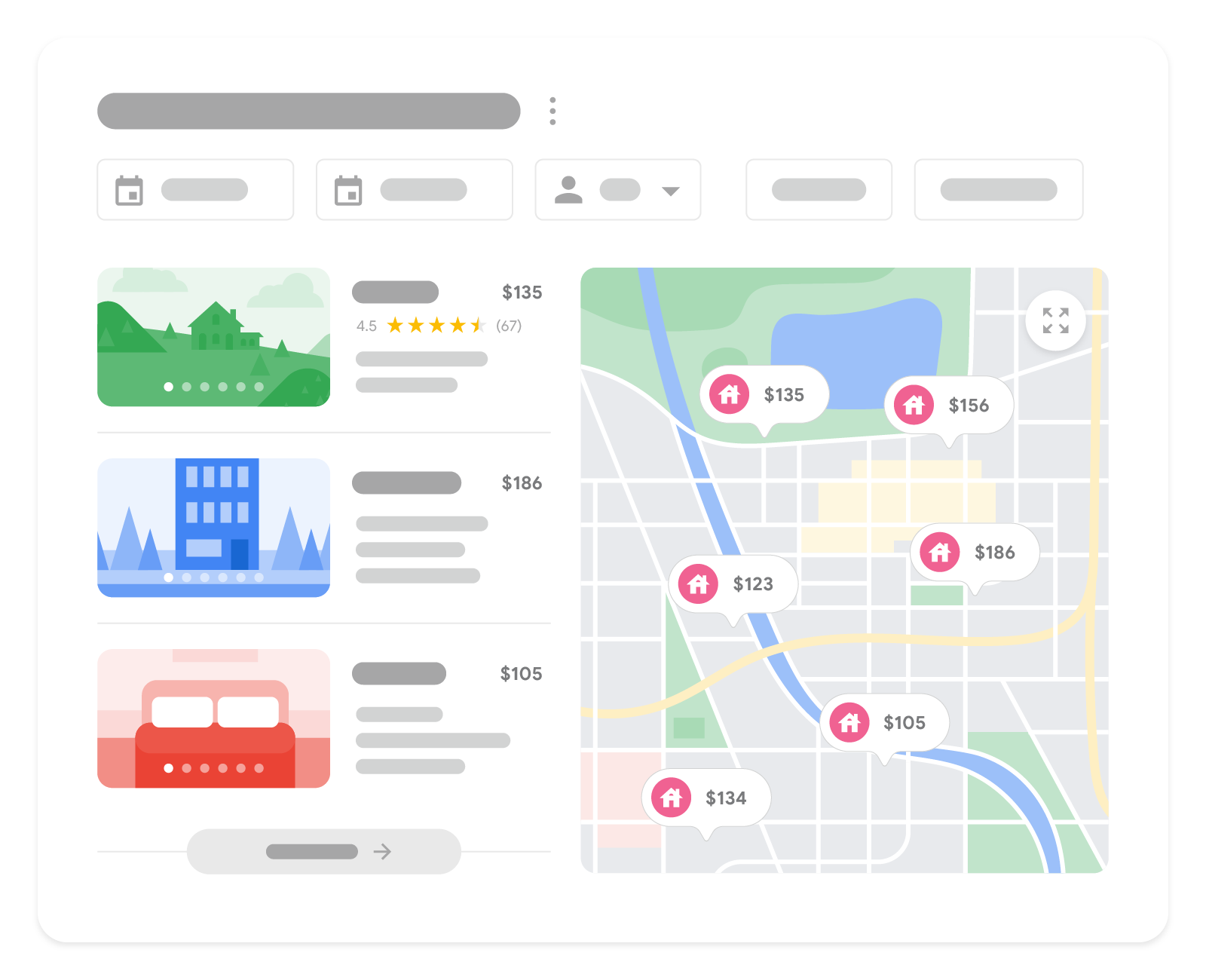
Google Vacation Rentals is a fundamentally different product. GVR is part of the broader Google Travel suite and acts as a metasearch engine, rather than an OTA. It aggregates real-time pricing and availability data and displays it natively inside standard Google Search results and Google Maps.
The critical difference lies in the conversion step. Google does not take bookings. When a traveler finds your cabin or apartment on Google Maps and clicks "Book," Google redirects that traveler directly to your own website (or your certified connectivity partner’s platform) to complete the transaction. Google acts purely as the discovery layer; you control the conversion layer. This allows you to capture a massive audience without surrendering control of your brand or paying platform commissions.
2. Head-to-Head: 2026 Feature Comparison Table
How do these platforms compare at a glance for a professional property manager?
| Feature / Metric | Booking.com | Google Vacation Rentals |
| Primary Business Model | Traditional Online Travel Agency (OTA) | Metasearch & Direct Booking Redirect |
| Host Commission | 15% Base (Up to 23% with premium programs) | 0% (Zero platform commission) |
| Payment Processing | 1.1% – 3.1% via Payments by Booking.com | Host uses their own processor (e.g., Stripe) |
| Guest Vetting & Reviews | One-way (Guests review hosts only) | Handled entirely by the host |
| Platform Damage Insurance | Basic liability only; no direct property protection | None (Host must secure own STR insurance) |
| Guest Data Ownership | Booking.com owns the guest data | The host owns the guest data entirely |
| Tech Requirement | Manual upload or Channel Manager | Channel Manager / API Partner strictly required |
3. The Financial Reality: Unpacking the Hidden Costs
Understanding the true cost of acquisition is the most critical skill for a property manager in 2026. The financial mechanics of these two platforms could not be more different, and failing to calculate your Net RevPAR (Revenue Per Available Room after distribution costs) can silently drain your profits.
The True Cost of Booking.com
Booking.com is famously expensive for operators because its commission is calculated on the total gross amount paid by the guest—including your cleaning fees and any additional service charges.
While the standard base commission is advertised at 15%, the reality of operating successfully on Booking.com often pushes that number much higher:
- Base Commission: ~15% globally.
- Payments by Booking.com: If the platform processes the guest's credit card, they charge an additional 1.1% to 3.1%, depending on the country.
- The Genius Program: To rank higher, many hosts are effectively forced to join the Genius loyalty program, which requires them to fund a 10% to 20% discount out of their own pocket for frequent travelers.
- Preferred Partner Program: If you want a "thumbs up" badge and higher algorithmic visibility, you must opt into this program, which adds an additional 3%-8% to your commission.
When you factor in payment processing and visibility programs, the effective cost of a Booking.com reservation often ranges from 18% to 23%.
The Zero-Percent Advantage of Google Vacation Rentals
Google’s financial proposition is dramatically simpler: 0% commission.
Because Google redirects the traveler to your direct booking website, there are no OTA service fees, no host commissions, and no mandatory discount programs. Your only financial obligations are:
- The standard credit card processing fee (typically ~2.9% + $0.30 via Stripe).
- The monthly software subscription for your property management system (PMS) that connects to Google's API.
By shifting just 20% of your OTA bookings to Google Vacation Rentals, you instantly reclaim thousands of dollars per property annually that would otherwise have gone to Booking.com.
Key insight: A $1,000 reservation on Booking.com (Preferred Partner) nets you roughly $800. That exact same $1,000 reservation via Google Vacation Rentals nets you $970. Scale that across an entire year, and distribution costs become the defining factor of your business's success.
4. Target Audiences & Booking Behavior
To maximize your occupancy calendar, you must understand who is using these platforms and how they behave.
The Booking.com Guest: Volume and Velocity
Booking.com has unparalleled reach in Europe and a rapidly growing footprint in North America. The platform attracts a massive mix of international tourists, business travelers, and spontaneous weekenders.
Because the platform is fundamentally designed around hotel logic, guest behavior reflects this:
- High Cancellation Rates: Booking.com guests are notorious for booking multiple properties at once and canceling the ones they don't want at the last minute. If you use flexible cancellation policies here, expect a high churn rate.
- Shorter Lead Times: Guests often book closer to their travel dates than on other platforms.
- Less Communication: Guests treat your short-term rental like a hotel. They expect instant confirmation, self-check-in, and minimal back-and-forth chatting.
The Google Guest: High Intent and Brand Discovery
Travelers who use Google Vacation Rentals are typically highly intentional. They start their journey on a blank search bar, typing specific queries like "beachfront rentals in Maui" or dragging around on Google Maps to find accommodations near a specific landmark or conference center.
- Longer Booking Windows: Because these guests research specific destinations well in advance, Google traffic often secures your calendar weeks or months ahead.
- Direct Relationship: Because they land on your website to book, they see your branding, read your specific terms, and establish a direct relationship with you. This makes them significantly easier to re-target for future direct bookings, turning a one-time guest into a loyal, repeat customer.
5. Host Protections, Vetting, and Operational Risks
When you open your doors to the public, risk mitigation is paramount. Relying on an OTA versus a direct booking channel dramatically shifts the burden of responsibility.
Operating on Booking.com
Booking.com does not utilize a two-way review system. Guests review your property, but you cannot review the guest, nor can you see a guest's past reviews before accepting their reservation. This "blind" booking process—combined with the inability to easily collect security deposits natively through the platform—makes guest screening incredibly difficult.
Furthermore, Booking.com’s insurance protections are significantly weaker than Airbnb’s AirCover. They offer basic liability coverage, but direct property damage caused by a guest is generally your problem to solve.
Operating via Google Vacation Rentals
With Google, you are operating entirely independently. Google is the matchmaker; they bear zero liability for the stay. Because the guest books through your website, you have complete operational freedom—and total responsibility.
You must implement your own guest screening protocols, mandate digital rental agreements, enforce your own security deposits, and carry comprehensive commercial insurance for short-term rentals.
While this requires more setup, professional property managers prefer this model. It ensures you are never at the mercy of a third-party OTA's arbitrary customer service agent deciding whether to refund a guest who broke your house rules.
6. The Algorithm Games: Visibility and SEO
How do you actually get your property seen on these massive networks?
Mastering Booking.com
Booking.com is a pure "pay-to-play" algorithmic environment. Organic SEO matters very little. Your ranking is determined by your conversion rate, your cancellation rate, and your willingness to sacrifice margin. If your property is buried on page four, the platform explicitly encourages you to use the Visibility Booster—a tool that temporarily increases your commission rate to 20% or 25% to artificially boost your ranking.
Mastering Google Vacation Rentals
Google relies on hard data, speed, and exact pricing parity. To rank well on GVR, you must excel in technical SEO and channel management:
- Rate Parity: Google explicitly prioritizes the best price. If your property is listed on Booking.com for $200 and on your direct site for $180, Google will highlight your direct site with a bright green "Official Site" badge.
- Data Accuracy: Google's API requires blazing-fast updates. If a guest clicks a price on Google and lands on your site only to find the price has jumped due to hidden fees, Google will penalize your listing and drop your visibility.
7. The Tech Stack: Scaling with Smoobu
It is structurally impossible to manually manage a listing on Google's travel ecosystem. Google strictly requires properties to be pushed through an approved API connectivity partner. Furthermore, if you are listed on Booking.com, the sheer velocity of instant bookings means that a manual calendar update will inevitably result in a disastrous double-booking.
To successfully manage a multi-channel strategy in 2026, you must utilize a powerful property management system (PMS) and channel manager. This is where Smoobu becomes the ultimate operational hub for your business.
Smoobu is specifically designed to centralize your operations and bridge the gap between third-party OTAs and your own direct booking efforts. As an official Premier Plus Connectivity Partner for Booking.com and a Preferred Software Partner for Airbnb, Smoobu allows you to manage the complexity of global distribution from one dashboard:
- Instant Calendar Synchronization: When a guest books a weekend on Booking.com, Smoobu's API instantly blocks those exact dates on Airbnb and Expedia—ensuring zero double bookings.
- The Google Connection: You cannot manually upload a property to Google. Smoobu handles your Google visibility seamlessly through its official HomeToGo integration. Your live rates, availability, and photos are syndicated from Smoobu to HomeToGo, which then automatically pushes your listing into Google search results via Google Vacation Finder.
- Centralized Pricing Management: You can set a base price in Smoobu and apply automated, channel-specific markups using the Smoobu Dynamic Pricing and synchronization tools. For example, you can automatically mark up your Booking.com rates by 15-18% to absorb their high commissions, while independently adjusting your HomeToGo pricing to account for their specific fee structure for Google-originated bookings.
- Unified Guest Communication: Whether the guest books via the Booking.com app, your own direct website, or discovers you on a Google search and books through HomeToGo, every message lands in a single centralized inbox, allowing you to trigger automated check-in instructions seamlessly.
Conclusion: Your 2026 Action Plan
You do not have to choose between Booking.com and Google Vacation Rentals. The most profitable operators in 2026 use them synergistically.
Use Booking.com strategically as a volume engine. Accept the higher commissions in exchange for filling your shoulder-season vacancies and gaining access to international travelers who would never have found you otherwise. But do not become dependent on it.
Simultaneously, leverage Google Vacation Rentals to build your direct booking pipeline. Use Google's massive metasearch reach to capture high-intent travelers, bypass OTA commissions, and build a database of past guests for future marketing.
Mastering distribution is the difference between running a stressful side-hustle and operating a scalable, highly profitable business. Stop giving away 20% of your revenue for free. Centralize your tech stack, push your properties to Google, and take back control of your business.
Leave a comment
Your email address will not be published.